


photo by Kelly Sikkema
Source of this activity:By Gary Antonick, New York Times
Tax Collector is played like this: Start with a collection of paychecks, from $1 to $12. You can choose any paycheck to keep. Once you choose, the tax collector gets all paychecks remaining that are factors of the number you chose. The tax collector must receive payment after every move. If you have no moves that give the tax collector a paycheck, then the game is over and the tax collector gets all the remaining paychecks.
The goal is to beat the tax collector.
Example:
Turn 1: Take $8. The tax collector gets $1, $2 and $4.
Turn 2: Take $12. The tax collector gets $3 and $6 (the other factors have already been taken).
Turn 3: Take $10. The tax collector gets $5.
You have no more legal moves, so the game is over, and the tax collector gets $7, $9 and $11, the remaining paychecks.
Total Scores:
You: $8 + $12 + $10 = $30.
Tax Collector: $1 + $2 + $3 + $4 + $5 + $6 + $7 + $9 + $11 = $48.
Questions:
Is it possible to beat the tax collector in this $12 game? If so, how? What is the maximum score you can get?
Bonus: What if you played the game with paychecks from $1 to $24? How about $1 to $48?

Task 1 (Source: Illustrative Math)
The 20 students in Mr. Wolf's 4th grade class are playing a game in a hallway that is lined with 20 lockers in a row.

This process continues until all 20 students in the class have passed through the hallway.

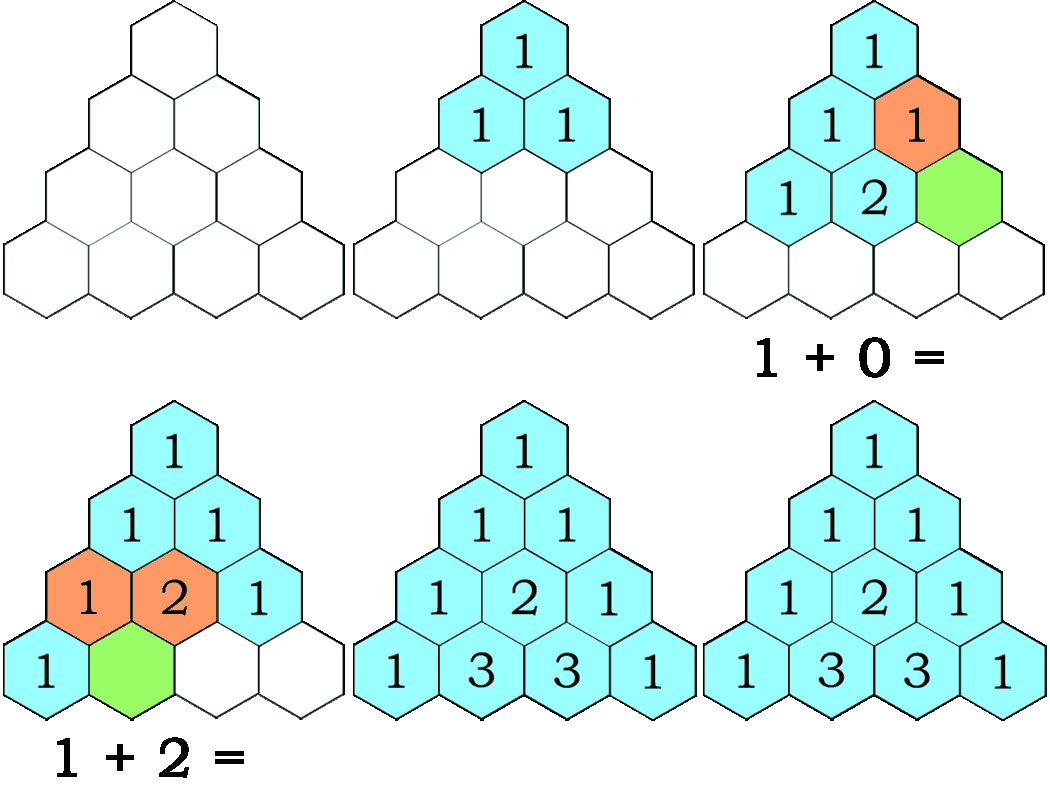
Blaise Pascal was another famous mathematician who in 1653 published his work on a special triangle following a specific pattern. This became known as Pascal’s triangle, even though many other cultures have studied this pattern thousands of years before. The observations made from Pascal’s triangle has led to patterns related to probability and statistics, which we will explore later in the semester.
Take a look at Pascal’s triangle. The first number starts with a 1. Then continue to place the number 1 on the left and right edge of each number 1 from above. To obtain the missing number below, you add the two adjacent numbers above them. For example, you add the adjacent numbers 1 and 2 to obtain 3 below them. Fill in the rest of the triangle.

Resource:Mary Ann Esteban
On Jamboard, work with your group friends to organize the following cards into Pythagorean triplets.

Part 1 (with cards)
Play with the tiles and create your own art. (Laminated the printouts, then used sticky magnets, students can easily rotate/move the tiles)


.png)


