What fraction is shaded?
"I was just guessing at numbers and figures Pulling your puzzles apart" [Coldplay]
Wednesday, May 2, 2018
Problem 42: Pink Triangle
Although an easy one, @solvemymaths's following similarity question on Twitter went viral on the Internet, so I have decided to keep it here:
Tuesday, May 1, 2018
Math Pics 4: Pentagonal Totals
I saw this on Twitter. It is an amazing work. The total of numbers on each side of the pentagon is equal to each other.
Saturday, April 21, 2018
Problem 39: Big Numbers
Which of these do you think is the biggest number?
-Number of cells in the human body
-Number of different orders you could shuffle a deck of cards
-Number of stars in the universe
-Number of seconds since the beginning of the time
-Number of stars in the universe
-Number of seconds since the beginning of the time
Source:@ToddMalarczuk
![]() |
| http://www.planetsmarty.com/2016/07/b-is-for-big-numbers.html |
Thursday, April 19, 2018
Problem 38: Analogy between two problems
I have been reading 'Why Don't Students Like School?' by Daniel Willingham, and I came across with these problems:
Problem 1:
Suppose you are a doctor faced with a patient who has a malignant tumor in his stomach. It is impossible to operate on the patient, but unless the tumor is destroyed, the patient will die.There is a kind of ray that can be used to destroy the tumor. If the rays reach the tumor all at once at a sufficiently high intensity, the tumor will be destroyed. Unfortunately, at this intensity, the healthy tissue the rays pass through on the way to the tumor will also be destroyed. At lower intensities, the rays are harmless to healthy tissue, but they will not affect the tumor either. What type of procedure might be used to destroy the tumor with the rays and at the same time avoid destroying the healthy tissue?*
Problem 2:
A dictator ruled a small country from a fortress.The fortress was situated in the middle of the country, and many roads radiated outward from it, like spokes on a wheel. A great general vowed to capture the fortress and free the country of the dictator.The general knew that if his entire army could attack the fortress at once, it could be captured. But a spy reported that the dictator had planted mines on each of the roads.The mines were set so that small bodies of men could pass over them safely because the dictator needed to be able to move troops and workers about; however, any large force would detonate the mines. Not only would this activity blow up the road, but the dictator would destroy many villages in retaliation. How could the general attack the fortress?**
The two questions describe similar phenomena, but the people who solved the first one or given the solution to the first one, mostly cannot answer the second one. Or they do not see the same relationship between the two triangles. Can you see?
*Willingham, Daniel T. Why Don't Students Like School?: A Cognitive Scientist Answers Questions About How the Mind Works and What It Means for the Classroom (p. 98). Wiley. Kindle Edition.
**Willingham, Daniel T. Why Don't Students Like School?: A Cognitive Scientist Answers Questions About How the Mind Works and What It Means for the Classroom (pp. 98-99). Wiley. Kindle Edition.
Problem 1:
Suppose you are a doctor faced with a patient who has a malignant tumor in his stomach. It is impossible to operate on the patient, but unless the tumor is destroyed, the patient will die.There is a kind of ray that can be used to destroy the tumor. If the rays reach the tumor all at once at a sufficiently high intensity, the tumor will be destroyed. Unfortunately, at this intensity, the healthy tissue the rays pass through on the way to the tumor will also be destroyed. At lower intensities, the rays are harmless to healthy tissue, but they will not affect the tumor either. What type of procedure might be used to destroy the tumor with the rays and at the same time avoid destroying the healthy tissue?*
Problem 2:
A dictator ruled a small country from a fortress.The fortress was situated in the middle of the country, and many roads radiated outward from it, like spokes on a wheel. A great general vowed to capture the fortress and free the country of the dictator.The general knew that if his entire army could attack the fortress at once, it could be captured. But a spy reported that the dictator had planted mines on each of the roads.The mines were set so that small bodies of men could pass over them safely because the dictator needed to be able to move troops and workers about; however, any large force would detonate the mines. Not only would this activity blow up the road, but the dictator would destroy many villages in retaliation. How could the general attack the fortress?**
The two questions describe similar phenomena, but the people who solved the first one or given the solution to the first one, mostly cannot answer the second one. Or they do not see the same relationship between the two triangles. Can you see?
*Willingham, Daniel T. Why Don't Students Like School?: A Cognitive Scientist Answers Questions About How the Mind Works and What It Means for the Classroom (p. 98). Wiley. Kindle Edition.
**Willingham, Daniel T. Why Don't Students Like School?: A Cognitive Scientist Answers Questions About How the Mind Works and What It Means for the Classroom (pp. 98-99). Wiley. Kindle Edition.
Monday, April 16, 2018
Platonic Solids
Plato and his disciples were so fascinated by the idea that there were only 5 regular polyhedra that each associated to a natural element: the tetrahedron with the fire, the Hexahedron to the Earth, the octahedron to the air, the dodecahedron to the cosmos and the icosahedron to water. (source)
Plato believed that geometry hid sacred truths describing reality. They say that when he founded the School of Athens in 387 BC he placed a sign at the entrance that said: "Let no one ignorant of the geometry between here."
Sunday, April 15, 2018
Problem 37: One wasn't square
A great question from nrich. Although this is for Stage 2, I believe my students will like it too.
------------------------------------
Mrs Morgan, the class's teacher, pinned numbers onto the backs of three children: Mona, Bob and Jamie.
"Now", she said, "Those three numbers add to a special kind of number. What is it?"

Michael put his hand up.
"It's a square number", he answered.
"Correct", smiled Mrs Morgan.
"Oh!" exclaimed Mona, "The two numbers I can see also add to a square!"
"And me!" called out Bob, "The two numbers I can see add to a square too!"
"Oh dear", said Jamie disappointedly, "the two numbers I can see don't add to a square! It's either 5 too little or 6 too big!"
What numbers did the three children have on their backs?
Monday, April 9, 2018
Sunday, April 8, 2018
Thursday, April 5, 2018
Problem 35: 2-Digit Numbers Challenge
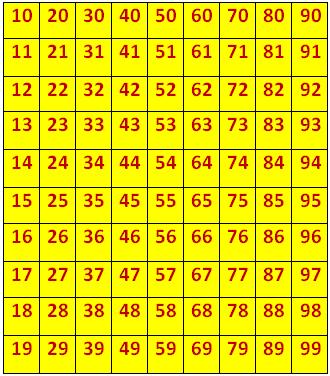
Using each of the addition, subtraction,
multiplication and division operations one time at most, what is the
i. highest number can you get?
ii. lowest number can you get?
Monday, April 2, 2018
Sunday, April 1, 2018
Problem 34: Polygon Area Ratio
Subscribe to:
Comments (Atom)